
Satisfies 1 requirement
Factory Sales of High - Quality Glass Tempering Furnace
US$180,000.00-280,000.00
1 set(MOQ)

I have found results from20000+products and9000+suppliers aboutGlass tempering furnace

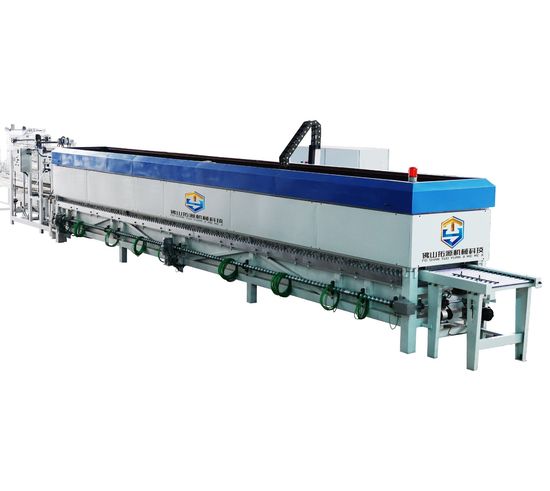


Selecting a glass tempering furnace requires a deep dive into heating technology, glass types, and production capacity. You must prioritize forced convection technology if you intend to process Low-E glass, as it ensures uniform heating of the coated surface. Evaluate the quench system design, specifically the precision of air pressure control, which directly impacts the fragmentation state and optical quality of the final product. Ensure the furnace supports the thickness range (typically 3mm to 19mm) and maximum glass dimensions required for your specific market, such as architectural or automotive glass.
Buyers must verify that the equipment meets CE certification for the European market or UL/CSA standards for North America. Key technical benchmarks include energy consumption per square meter (strive for <0.45 kWh/m² for 5mm clear glass) and heating power stability. Ensure the PLC system is from a reputable global brand like Siemens or Schneider to guarantee long-term software reliability and ease of sourcing spare parts. Additionally, check for compliance with ISO 9001 quality management systems at the manufacturer's facility.
Performance is measured by the flatness (bow and warp) and the optical distortion of the tempered glass. Request test reports showing compliance with ASTM C1048 or EN 12150-1. A high-quality furnace should feature intelligent heating control with multiple independent zones to prevent 'saddle' or 'dish' deformations. It is highly recommended to request a live video factory audit or a third-party inspection to witness a dry run and glass stress test before final payment.
Due to the high-temperature environment, ceramic roller maintenance is critical; ensure the supplier provides a SO2 (Sulfur Dioxide) injection system or specialized cleaning tools to prevent 'white spots.' Evaluate the supplier's remote diagnostic capabilities—top-tier manufacturers offer 24/7 online technical support via VPN to troubleshoot PLC issues. Confirm the availability of a wear-parts package (including Kevlar ropes, heating elements, and thermocouples) to be shipped with the initial order to minimize operational downtime.
The biggest risks involve damage during maritime transit and installation failure. Because these machines are oversized, they require Open Top (OT) or Flat Rack containers. Ensure the contract specifies vacuum packaging for electronic cabinets and anti-rust coating for all mechanical parts. To mitigate installation risks, negotiate a contract that includes on-site commissioning by the supplier's engineers and a clear definition of 'Acceptance Criteria' based on yield rates and glass quality samples.
For high-value industrial equipment, use a Letter of Credit (L/C) or a staged Telegraphic Transfer (T/T). A common professional structure is 30% deposit, 60% after successful FAT (Factory Acceptance Test), and 10% as a retention bond after 6 months of stable operation. Always conduct your sourcing through reputable platforms like Made-in-China.com, utilizing their secured payment services and supplier audit reports to verify the manufacturer's legal standing and export history.
Given the weight and volume, FOB (Free On Board) or CIF (Cost, Insurance, and Freight) are standard. However, DAP (Delivered At Place) is often preferred for large plants to ensure the supplier manages the complex inland heavy-lift transport. Ensure you have a comprehensive marine insurance policy that covers 'loading and unloading' risks. For the destination country, verify import duties on heavy machinery and ensure the HS Code (typically 8417) is correctly classified to avoid customs delays.