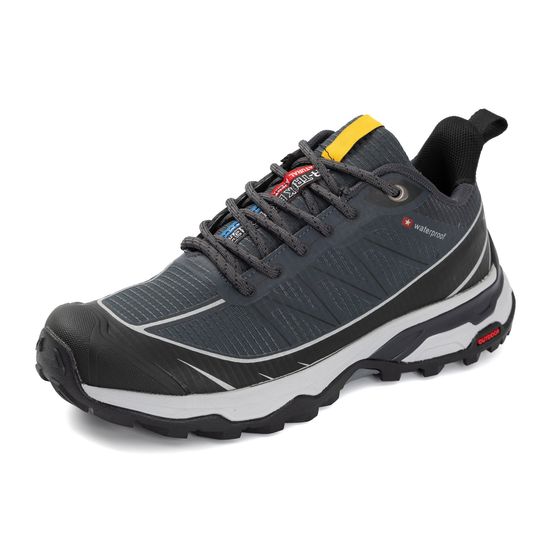
Women's Water-Resistant Hiking Shoes Hybrid Sole Zapato for Outdoor Trekking Sports Footwear

Wholesale Customizable Women's Hiking Shoes Lady Outfit Walking Sports Footwear

Hiking Shoes Sneakers Athletic Trail Running Zapato Waterproof Footwear

I have found results from10000+products and7000+suppliers aboutHiking shoes for women


When evaluating hiking shoes, prioritize waterproof membranes (such as GORE-TEX or proprietary alternatives) and breathability ratings to ensure foot comfort. The outsole material should be high-traction rubber (e.g., Vibram or equivalent) with a lug depth of 4-5mm for multi-terrain grip. Additionally, check for EVA or PU midsoles for shock absorption and reinforced toe caps to protect against impact.
For the US market, ensure compliance with ASTM F2413 if safety features are included, and check for PFAS-free water-repellent coatings due to evolving state regulations. For the EU, products must meet REACH chemical safety standards and potentially CE marking if marketed as Personal Protective Equipment (PPE). Always verify ISO 20344/20347 for general footwear testing methods.
Request third-party lab reports focusing on flex resistance (minimum 50,000 flexes without cracking), sole abrasion resistance, and bond strength between the upper and the sole. It is highly recommended to perform a hydrostatic head test on waterproof models and a colorfastness test to ensure dyes do not bleed when wet.
Look for suppliers capable of anatomical last adjustments specifically for women’s foot shapes (typically narrower heels and higher arches). Professional suppliers should offer private labeling, customized insoles (orthopedic or memory foam), and sustainable material options like recycled polyester uppers, which are currently in high demand.
Utilize Trade Security services provided by reputable platforms like Made-in-China.com to ensure payment safety. Always conduct a factory audit (either in-person or via a third-party like SGS/Intertek) to verify the supplier's production capacity and business license before transferring large deposits.
Negotiate based on Total Cost of Ownership (TCO) rather than just the unit price. For initial orders, aim for a tiered MOQ (e.g., lower MOQ for trial colors, higher for core black/brown models). You can often secure a 5-10% discount by committing to a yearly volume forecast or by choosing FOB terms if you have a reliable freight forwarder.
Footwear is volume-heavy; therefore, optimizing packaging (e.g., using flat-packed boxes or eco-friendly mailer bags) can significantly reduce freight costs. Ensure the supplier provides a detailed packing list and HS Code 6403 (or 6402 depending on material) to avoid customs delays and ensure accurate import duty calculation.
Include a Quality Agreement in your contract that specifies a Defective Allowable Percentage (usually 1-2%). If defects exceed this, ensure the contract stipulates credit for future orders or partial refunds. Always document issues with high-resolution photos and videos within 15 days of cargo arrival to support your claim.