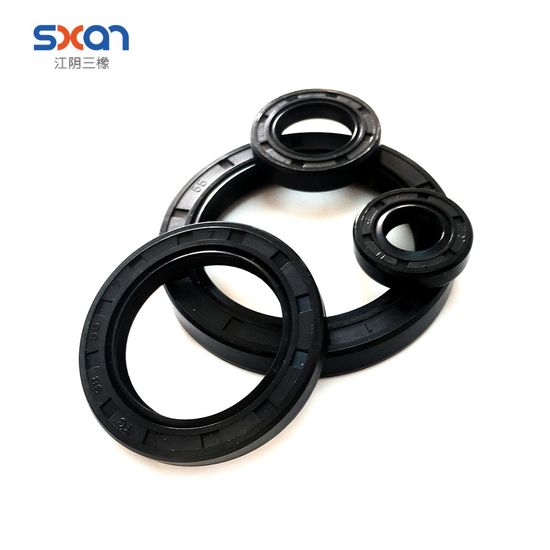
for Honda 91212-R1b-A01 Half Shaft Oil Seal Nok Koyo NBR

for Honda 91214-Pna-014 Half Shaft Oil Seal Nok Koyo NBR

Wholesale Rubber Oil Seal for Honda 91207-P0X-003 Front Crankshaft Shaft Seal

I have found results from4000+products and1000+suppliers aboutKoyo oil seal


When selecting Koyo oil seals, you must prioritize material compatibility and dimensional precision. Ensure the elastomer material—such as NBR (Nitrile) for general use, FKM (Viton) for high temperatures, or Silicone—matches your specific fluid and thermal environment. Verify the Inner Diameter (ID), Outer Diameter (OD), and Width against OEM standards, as even a 0.1mm variance can lead to leakage or premature failure. Additionally, confirm the lip design (e.g., single lip vs. double lip with dust protection) to suit the application's contamination levels.
Authenticity is critical for mechanical integrity. Request Material Test Reports (MTRs) and Certificates of Conformity from the supplier. Look for manufacturers that adhere to ISO/TS 16949 or ISO 9001:2015 quality management systems. For high-performance applications, ask for pressure tolerance ratings and rotational speed limits (RPM). A reputable supplier on Made-in-China.com should be able to provide clear photos of the laser-etched branding and packaging security features to prevent counterfeit risks.
Koyo oil seals are primarily used in automotive transmissions, crankshafts, industrial gearboxes, and hydraulic systems. The functional requirement is to prevent lubricant leakage while simultaneously blocking external contaminants like dust and moisture. For heavy-duty machinery, ensure the seal features a garter spring made of stainless steel or carbon steel to maintain constant radial load on the shaft, ensuring a tight seal even under vibration.
Depending on the destination market, products should comply with REACH and RoHS directives to ensure they are free from hazardous substances. For automotive applications, compliance with IATF 16949 is the gold standard. If the seals are used in food processing machinery, they must meet FDA-grade material requirements. Always confirm that the supplier provides standardized export packaging to prevent deformation during long-transit maritime shipping.
Counterfeiting is a significant risk in the bearing and seal industry. To mitigate this, avoid prices that are significantly lower (30%+) than the market average, as these often indicate sub-standard materials. Utilize the 'Audit Reports' available on Made-in-China.com to verify the supplier's factory scale and business legitimacy. Always request a sample for lab testing or hardness (Durometer) verification before placing a bulk container order.
Focus on Total Cost of Ownership (TCO) rather than just the unit price. Negotiate based on volume tiers; for example, increasing an order from 1,000 to 5,000 units can often yield a 10-15% discount. For lead times, establish a penalty clause for delays exceeding 7 days. Standard lead times for non-stocked oil seals are typically 15-25 days, so plan your inventory cycles accordingly to avoid stockouts.
Oil seals are sensitive to pressure and heat. For small batches, Air Express (DHL/FedEx) is preferred to minimize transit time. For bulk sea freight, ensure the supplier uses moisture-proof inner packaging and reinforced outer cartons to prevent crushing. Specify FOB (Free On Board) terms if you have a preferred forwarder, or CIF (Cost, Insurance, and Freight) if you want the supplier to handle the logistics risk until the port of destination.
Always use Secured Payment services provided by the platform to ensure your funds are only released after you confirm receipt of the goods. Avoid direct wire transfers to private bank accounts. For large orders, consider a 30% deposit and 70% balance payment against the Bill of Lading (B/L) and a successful third-party pre-shipment inspection (PSI) report.