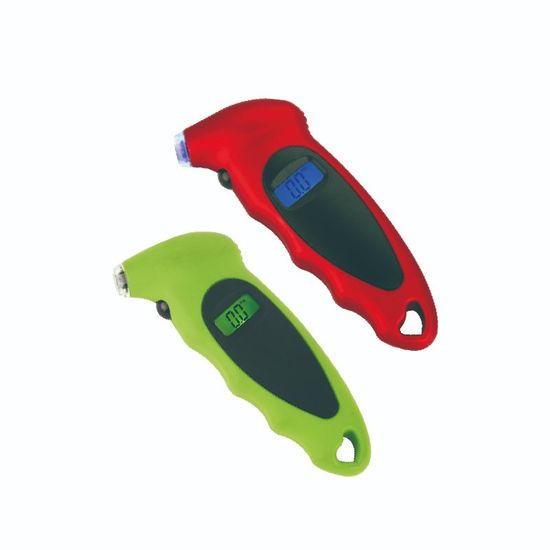
Tire Gauge Wholesale 2.5 Inches Booted Tire Pressure Gauge

Rubber Booted Tyre Pressure Meter Wholesale Low Pressure Tire Gauge

Best Tire Gages Wholesale Low Pressure Gauge Tire Pressure

I have found results from400+products and200+suppliers aboutWholesale tire pressure gauge


When sourcing at scale, you must distinguish between Digital, Analog (Dial), and Pencil (Stick) gauges. Digital gauges are preferred for high precision and ease of use, often featuring backlit LCDs for low-light conditions. Analog dial gauges are valued for their durability and battery-free operation, making them ideal for long-term storage. Pencil gauges are the most cost-effective for promotional giveaways or basic retail. Ensure the chosen type matches your target market's preference for either portability or high-tech functionality.
Accuracy is the most critical metric. Look for gauges that comply with ANSI B40.1 Grade B or ISO 12176 standards. For standard passenger vehicles, a range of 0-60 PSI is sufficient, but for commercial trucks, you must source gauges capable of reaching 150-200 PSI. Verify the measurement units supported (PSI, BAR, KPA, Kg/cm²) to ensure compatibility with international markets. Additionally, check for pressure reset buttons and air release valves which enhance the tool's utility.
For professional-grade sourcing, prioritize heavy-duty metal bodies (zinc alloy or brass) over cheap plastics. The nozzle/chuck should be made of solid brass to prevent thread stripping and air leakage. If sourcing digital models, ensure the housing is impact-resistant or encased in a rubberized protective sleeve to survive drops in a garage environment. For hose-connected models, the tubing should be braided stainless steel or high-grade reinforced rubber to prevent kinking and bursting.
To avoid customs delays, ensure products carry the CE mark for European markets and FCC certification for digital models sold in the US. If the gauge includes a lithium battery, it must have UN38.3 and MSDS reports for safe air and sea transport. For the Australian market, look for RCM compliance. Always request RoHS certification to ensure the materials used are free from hazardous substances, which is a standard requirement for most modern retailers.
Always request a pre-shipment inspection (PSI) by a third-party agency. Specifically, ask for a calibration test on a random sample of 5-10% of the order to ensure the margin of error is within ±1%. Using platforms like Made-in-China.com allows you to identify Audited Suppliers, which significantly reduces the risk of receiving sub-standard or 'counterfeit' precision tools.
Focus on tiered pricing based on volume; for tire gauges, a jump from 500 to 2,000 units can often reduce the unit price by 15-20%. Negotiate for customized packaging (OEM) and logo laser-etching, which are often included for free if the Minimum Order Quantity (MOQ) is met. Additionally, ask for a 2% spare parts allowance for digital units to cover potential battery or screen defects without needing to process international returns.
Tire pressure gauges are relatively small and dense, making them ideal for LCL (Less than Container Load) sea freight to save costs. However, if the gauges contain lithium batteries, they are classified as Dangerous Goods (DG) in air freight, which increases shipping costs. Consider sourcing 'battery-excluded' versions to lower shipping rates and allow your end-customers to install local, fresh batteries.
Utilize secure payment terms such as Letters of Credit (L/C) for very large orders or Escrow-based services provided by reputable platforms. Avoid direct wire transfers to unknown accounts. Ensure the Proforma Invoice (PI) clearly states the Incoterms (e.g., FOB, CIF), detailed product specifications, and the agreed-upon lead time to provide legal recourse in case of disputes.