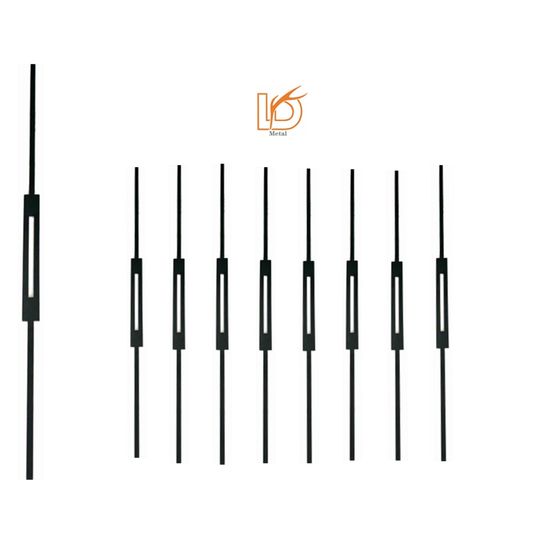
Wrought iron staircase guardrail manufacturers
I have found results from2000+products and900+suppliers aboutWrought iron staircase guardrail
Sourcing guidance for Wrought Iron Staircase Guardrail
What are the key material specifications to consider for wrought iron guardrails?
When sourcing wrought iron guardrails, prioritize Q235 or Q195 carbon steel for its excellent weldability and structural integrity. Ensure the wall thickness of the main handrail is at least 2.0mm, while pickets/balusters should be no less than 1.2mm to 1.5mm to prevent bending under pressure. For outdoor applications, specify hot-dip galvanizing as the base treatment to provide a 20-year rust-proof guarantee.
Which surface treatment technologies ensure the best durability and aesthetics?
The industry standard for high-quality guardrails is a multi-stage coating process. This includes sandblasting to remove impurities, followed by zinc-rich epoxy priming and a final electrostatic powder coating (AkzoNobel or Tiger brand). This process ensures the finish is UV-resistant, scratch-resistant, and maintains color stability even in high-traffic or coastal environments.
What international safety and compliance standards must the product meet?
For the US market, guardrails must comply with IBC (International Building Code) and IRC (International Residential Code), specifically the '4-inch sphere rule' (no gaps larger than 4 inches). In the UK/EU, look for BS 6180:2011 compliance. Ensure the supplier provides load-bearing test reports demonstrating the rail can withstand a concentrated load of 200 lbs (890N) applied at the top.
How can I ensure the guardrail is compatible with my specific staircase dimensions?
Request the supplier to provide CAD or 3D BIM drawings for approval before production. Professional manufacturers on Made-in-China.com usually offer customization for rake angles (pitch) and height. It is critical to verify the mounting method—whether it is top-mounted (flange) or side-mounted (fascia)—to ensure it aligns with your architectural substrate (wood, concrete, or steel).
Cross-Border Procurement & Risk Management for Wrought Iron Products
How can I mitigate the risk of receiving damaged or rusted goods during sea freight?
Wrought iron is heavy and susceptible to moisture. Insist on seaworthy packaging, which includes pearl cotton wrapping, bubble film, and reinforced wooden crates (fumigated). To prevent oxidation during long-term transit, request the placement of industrial-grade silica gel desiccant bags inside the packaging. Always use CIF or CIP terms with comprehensive insurance to cover potential transit damage.
What are the best strategies for negotiating with wrought iron manufacturers?
Focus on Total Cost of Ownership (TCO) rather than just the unit price. Negotiate based on weight-to-price ratios and volume tiers; for orders exceeding 500 linear meters, you can typically secure a 10-15% discount. Ask for a 'Golden Sample' to be kept by a third-party inspector to ensure the bulk production matches the approved quality of welding and finish.
How do I verify the credibility of a supplier on Made-in-China.com?
Prioritize 'Audited Suppliers' who have undergone on-site inspections by third-party agencies like SGS, Bureau Veritas, or TÜV Rheinland. Check their 'Full Audit Report' for production capacity and quality control systems. Use the Secured Trading Service (STS) to ensure your payment is only released to the supplier after you have confirmed receipt and quality of the goods.
What should I look for during a pre-shipment inspection (PSI)?
Hire a third-party inspector to perform a Cross-Cut Test (ISO 2409) to check paint adhesion and a Salt Spray Test (ASTM B117) report review. Crucially, verify the welding points for smoothness; there should be no visible slag, pits, or sharp edges that could cause injury. Ensure the quantity and dimensions match the packing list exactly to avoid customs clearance delays.