
Satisfies 1 requirement
Wholesale Restaurant Enamel Tray Enamel Baking Pan
US$1.50-3.60
2,000 Pieces(MOQ)

4000+ products and 2000+ suppliers results


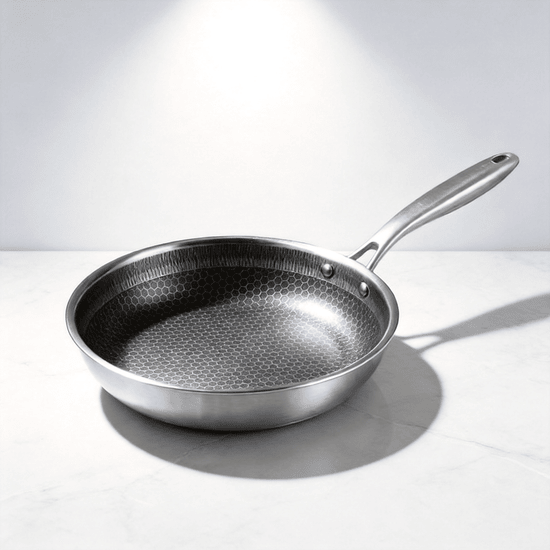


The term '18/10' refers to the composition of 18% chromium and 10% nickel. Chromium provides corrosion resistance and hardness, while the 10% nickel content is crucial for enhancing rust resistance and providing a high-gloss, silver-like luster. For B2B buyers, sourcing 18/10 ensures a food-grade, non-reactive surface that does not leach metallic flavors into food, meeting the high durability requirements of both professional kitchens and premium retail markets.
Since stainless steel is a poor heat conductor, you must verify the base construction. Look for 'Tri-ply' or 'Impact-bonded' encapsulated bases containing an aluminum or copper core. Ensure the aluminum core extends up the sides of the pan (Full Clad) for even heating, or is at least 5mm thick in the base for disc-bottom pans. This prevents hot spots and warping under high-temperature commercial use.
Products must adhere to strict food contact safety regulations. For the US market, ensure compliance with FDA GRAS (Generally Recognized as Safe) standards and California Prop 65. For the EU, products must meet LFGB (Lebensmittel- und Futtermittelgesetzbuch) and Regulation (EC) No 1935/2004. Always request heavy metal leaching test reports (specifically for Lead and Cadmium) from accredited third-party labs like SGS, TUV, or Intertek.
Prioritize riveted handles over welded ones for long-term structural integrity in heavy-duty environments. Handles should be 'Stay-Cool' hollow designs made of 201 or 304 stainless steel. For lids, tempered glass with steam vents is preferred for retail visibility, while heavy-gauge stainless steel lids are better for professional catering due to their unbreakable nature and superior heat retention.
Material substitution is a common risk. Request a Material Mill Certificate and perform a chemical spot test using a stainless steel reagent during the pre-shipment inspection. For large orders, insist on a PMI (Positive Material Identification) test to confirm the exact nickel and chromium percentages before the final balance is paid.
Focus on Total Cost of Ownership (TCO) rather than just the unit price. Negotiate for customized packaging (color boxes with drop-test certification) and ask for a 1-2% spare parts allowance for glass lids or knobs. If you are a high-volume buyer, request OEM/ODM branding (laser-etched logos) to be included in the unit price for orders exceeding 500-1,000 sets.
Stainless steel sets are heavy and prone to box crushing. Specify double-walled corrugated export cartons (five-layer) and individual bubble wrapping for each piece. For sea freight, ensure the use of desiccant silica gel packs inside the packaging to prevent 'container rain' or oxidation during long transit times across different climate zones.
Utilize Secured Trading Services provided by platforms like Made-in-China.com to ensure your funds are protected until the goods are shipped. Always use Letter of Credit (L/C) for very large volumes or Telegraphic Transfer (T/T) with a 30% deposit and 70% balance against the Bill of Lading (B/L) to maintain leverage over quality control.